
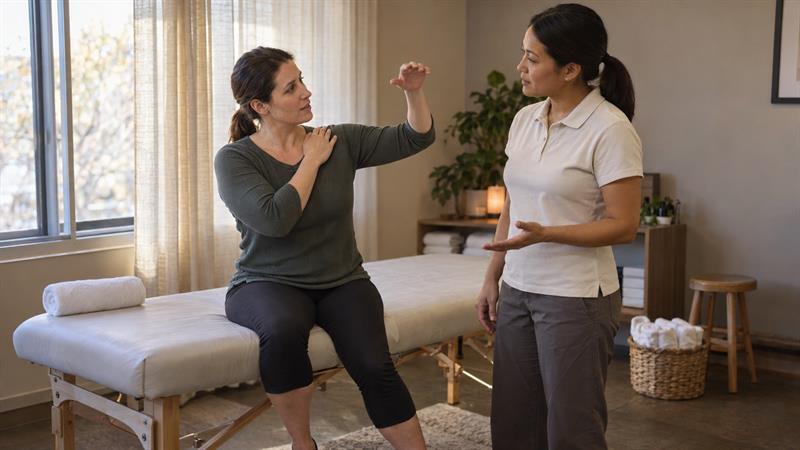
MV Massage Therapy LLC is a massage practice in Vienna, Virginia, serving clients from Vienna and Fairfax. Much of what brings someone to the table is physical — shifts spent lifting, gripping, reaching, or standing, and the stiffness that follows. A body that moves all day comes in tight in a different pattern than a body that sits still, and that difference is the reason the service choice is worth a thought before the appointment.
Searches for massage for repetitive strain usually come from someone whose week is built out of the same handful of movements. What sits underneath the question is rarely a technique name. It is a match: how much force the job asks for, how long it lasts, how often it repeats, and which side carries it.
Why Work That Uses the Body Leaves a Different Kind of Tightness
Repetition is the part that goes unnoticed. A single heavy lift announces itself; the smaller ones across a shift do not. What tends to build instead is a general heaviness in the muscles that did the most work, a grip that stays half closed on the drive home, or a low back that stiffens by early afternoon. The areas that feel overworked are usually the ones that were asked to hold, not the ones that were asked to move.
That is why a session starts with a conversation rather than a menu. Goals, focus areas, pressure preference, and any health information you want considered are settled before the hands start, and that short exchange is what turns a general appointment into one aimed at your working week.
Static work creates its own version of the problem, in different places. If the day is spent in a chair rather than on your feet, where tension settles for desk workers is the more relevant guide.
Massage for Overworked Muscles: Reading the Demand Before the Service Name
The name on the menu answers less than the demand does. Two people can both book deep tissue and need entirely different sessions, because the job that produced the tension is not the same job. Force is one variable: a hairstylist’s hands and a warehouse loader’s shoulders are not carrying the same load. Duration is another. Repetition is a third, and side matters more than most people expect — work is rarely symmetrical, and the body that does it rarely is either.
The practice offers Swedish/relaxation massage, deep tissue massage, signature massage, hot stone massage, aromatherapy, prenatal massage, and lymphatic drainage. Three of those are the ones this guide sets against physical work: Swedish, deep tissue, and signature. Hot stone, aromatherapy, and lymphatic drainage answer different requests, and they are covered further down.
Three Workload Patterns That Show Up in Physical Jobs
Grip and hand work loads the forearms and hands: tools, styling, crates, a till, scissors, a mouse held too long. Reach and overhead work loads the shoulder and upper back: shelves above the head, ladders, hoses, a child lifted out of a car seat. Load and carry puts the demand through the low back, hips, and legs: boxes, trays, patients, equipment.
Most jobs are a mix of two, and one usually dominates. A chef grips, reaches, and stands. A mover lifts, carries, and climbs. Naming the dominant pattern is not a diagnosis and does not need to be precise. Knowing whether the week is mostly grip, mostly reach, or mostly carry is enough to narrow the service choice, and it is the kind of detail a therapist can work from.
Where Swedish Fits: Days That Drain More Than They Strain
Swedish massage is a gentle, full-body session built on long, flowing strokes and light to medium pressure, usually covering the whole body unless another focus is requested. Its fit is the week that has left you worn out rather than locked in one spot — busy, on your feet, moving between tasks, but without a single area carrying a repeated load hard enough to hold.
Think of the difference between tired and tight. A draining week produces the first. A taxing one produces the second, usually in one place. When the whole body is flat and heavy instead, the Swedish relaxation massage service works through the entire frame at a pace that stays unhurried.
Where Deep Tissue Fits: One Area Doing More Than Its Share
Deep tissue massage uses firm pressure and slow, deep strokes that work toward the deeper layers of muscle and connective tissue, with attention to the areas that feel tight. The pace is slower and the geography is narrower, which is why it suits the pattern where one region has been doing more than its share: a shoulder from overhead work, the forearms from a grip, the low back from lifting.
If your week has a clear hot spot, deep tissue massage at MV Massage Therapy is the more direct match. The work stays on that region long enough to matter rather than spreading a light pass over everything. What to expect in a deep tissue session covers the pacing, the pressure conversation, and how the areas get chosen.
Where Signature Fits: A Workday That Asks for Both
Signature massage is a fusion of techniques — Swedish work, deep tissue, trigger point therapy, and myofascial release — arranged around what you want from the session. That blend is the point. A single appointment can open with broad, calming work and then narrow onto the two or three places the job has worn down.
The fit is a working week that leaves one side loaded and the whole body tired, or a person who would rather not choose between calming and focused work. The signature massage service is planned in the room rather than from a fixed script, and choosing between the three by how each one feels is worth reading if the decision is still open at this point.
Massage for Sore Muscles From Work: What to Say When You Book
A booking message does not need medical language. Five details do most of the work:
- The task you repeat most — lifting, gripping, reaching, carrying, or standing.
- The tool or grip involved — a wrench, a keyboard, scissors, a ladder, a tray.
- Which side works harder, and whether that has changed.
- The hours or the season that made it worse — a double shift, a busy month, cold weather.
- What a bad day feels like compared with a normal one.
That is usually enough for a session to be planned before you arrive. Pressure can be changed and an area can be skipped at any point, so the plan stays adjustable once the work begins. Questions ahead of time go through the contact page, and appointments are booked in advance. Much of the massage for physical work people ask about is really a question about which service fits the demand of the job, and those five details are how the answer gets found.
Massage for Repetitive Strain: What to Describe Without a Diagnosis
Massage is not a substitute for medical care, and the practice does not diagnose conditions or manage injuries. Pain that is sharp, new, spreading, or paired with numbness or weakness belongs with a clinician first. That boundary is not a formality. It is the difference between a session that gives you an hour of rest and a plan that someone qualified should be making.
What you can do here is describe the pattern plainly: what repeats, for how long, in which hand, and what makes it worse. A therapist can work from that description without naming a condition, and the choice between the three services often follows from it directly.
How the Work Week Shapes Timing and Session Length
Swedish, deep tissue, and signature massage are each offered in four session lengths: 45, 60, 75, and 90 minutes. Length is a practical decision before it is anything else. Forty-five minutes covers one region well. Sixty leaves room for that region and the area it has been pulling on. Seventy-five and ninety are for a whole-body pattern, two regions, or a week that has earned a slower pace.
The useful habit is to count the areas that need attention before choosing the clock. One hot spot and a tight opposite side is a different booking from a body that is tired everywhere. Length is settled when the appointment is made, which is also the moment to say whether you would rather have more time in one place than a full sweep.
When One of the Other Services Fits Better
Not every working body wants pressure. Lymphatic drainage is performed by Margarita personally, and it moves at a much lighter pace than any of the three services above. Hot stone work and aromatherapy are on the menu as well, for anyone who would rather have warmth or scent in the room than focused tension work.
In-home visits are available in Vienna and Fairfax, with the address confirmed when the appointment is booked. For a workday that leaves no room to drive anywhere afterward, that is a real alternative to a studio appointment, and the hands-on work does not change with the setting.
Key Takeaways
Matching a massage to physical work comes down to a few practical points.
- The demand matters more than the label: force, duration, repetition, and side.
- Swedish suits a week that has drained you; deep tissue suits one region doing too much.
- Signature covers the mixed week, with broad work first and focused work after.
- Five details at booking — task, tool, side, timing, bad days — do more than any service name.
Conclusion
The service follows the demand, not the other way around. Grip, reach, lift, and stand each leave their own mark, and a session planned around yours spends its hour where the work actually landed. When you are ready to choose a length and a time, book an appointment with MV Massage Therapy, and describe the working week in your own words.
⚠️ File-mutation verifier: 1 file edit(s) FAILED this turn despite any wording above that may suggest otherwise. Run `git status` or `read_file` to confirm what actually landed.
• `/home/richard/.hermes/cache/scratch/find_payload.py` — [write_file] Refusing to overwrite `/home/richard/.hermes/cache/scratch/find_payload.py`: `/home/richard/.hermes/cache/scratch/find_payload.py` exists but this task has not seen its full current c…