Quick Answer: A common preparation failure is clearing furniture without leaving enough room for the therapist to move around the table. To prepare for an in-home massage in Vienna, clear enough floor space around the table, set the light and temperature, and send a short note about pressure, focus areas, and areas to avoid. MV Massage Therapy LLC brings the equipment and massage supplies needed for the appointment, so your job is to make the room private, stable, and interruption-free.
Why a Prepared Space Makes In-Home Massage Easier
A prepared space works when it removes three frictions: movement, privacy, and interruption. The therapist handles the session, but you control the environment. When the room is set before the therapist arrives, the session starts faster and feels calmer from the first minute.
Preparation is not about creating a spa. It is about giving the therapist room to set up and giving you room to settle. A common pattern in in-home appointments is clearing the furniture but not leaving enough working space, which forces the therapist to reach around the table and breaks the rhythm of the session.
In many Vienna homes, in-home massage happens in a bedroom, living room, home office, or guest room that serves another purpose during the day. The space does not need to be perfect. It needs to support the table, the linens, the therapist, and your ability to stay relaxed through the session.
How to Prepare for an In-Home Massage in a Few Simple Steps
The fastest way to prepare is to complete six tasks before the therapist arrives. These steps apply to any in-home service, whether you are booking Swedish relaxation, deep tissue, hot stone, prenatal massage, aromatherapy, or lymphatic drainage.
- Clear enough floor space for the table and the therapist’s working area.
- Check that there is enough room for the therapist to work on both sides of the table.
- Set the room to a comfortable temperature for lying down.
- Dim the lights and reduce unnecessary noise.
- Plan for pets, children, and other household members for the full session window.
- Write a short note with focus areas, pressure preference, and areas to avoid.
If this is your first in-home session, review what to expect from an in-home massage appointment before the day begins. That makes the setup feel less like guesswork and more like a short routine.
Step One: Create Enough Space for the Table and Therapist
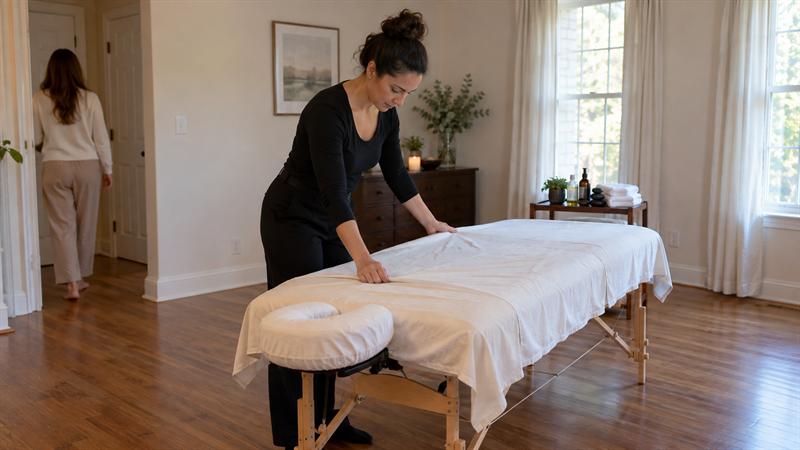
The space requirement is simple: clear enough room for the table, the therapist, and safe movement around you. That clearance gives the therapist room to work through the shoulders, back, legs, and feet without stepping over you.
Recommended Space for a Portable or Standing Massage Table
A portable massage table takes up space, but the therapist also needs working room around it. There is more comfort when the session includes hot stones, positioning supports, or other treatment equipment.
- Keep the sides of the table clear for kneading and oil work.
- Leave room at each end where you may sit up, adjust, or change position.
- Leave room at the foot end for leg and foot positioning during the session.
If the table is too close to a wall, the therapist has less room to work comfortably, and the start can feel rushed. The goal is a clear working path so the session begins with control.
Flooring, Cords, and Safe Movement Paths
Flooring matters more than most clients expect. A rug edge can catch a table leg, and a hard floor can make table legs less stable if the table is not positioned correctly. Tile and other hard surfaces need stable footing when you get on and off the table.
- Remove loose rugs, extension cords, pet toys, shoes, and small furniture from the setup zone.
- Make sure the table legs stand on a stable, even floor surface.
- Keep a clear path from the table to a stable spot where you can sit down safely.
A room that looks clear can still have small objects scattered near the table. Those objects can slow setup and make position changes less safe. Do a final walk around the setup zone before the therapist arrives.
Children, Pets, and Interruptions
A massage session works best when the space stays calm. Pets are a common source of interruption because even calm animals shift, sniff, or react to new scents and sounds. Children need a short, clear plan so the session does not become a negotiation halfway through.
- Keep pets in another room or crate with a familiar blanket and a quiet activity.
- Give children a simple instruction, such as staying in their own room or working at a distance.
- Tell partners and roommates the appointment time and ask them to wait outside the room.
If privacy is left to chance, a phone, a door, or a pet can reset the session. The easiest fix is to set the household rule before the therapist arrives, not after the first interruption.
Step Two: Set Up Privacy, Light, Temperature, and Atmosphere
Privacy and atmosphere matter more than decoration. The room does not need candles, a playlist, or a scented diffuser. It needs enough visual privacy, a comfortable temperature, and enough airflow for the session to feel professional.
Light, Music, Ventilation, and Scent
Dim the overhead lights enough that the room feels separate from the rest of the home. A lamp, a closed curtain, or low natural light is enough. Soft music or silence both work. The important point is that the sound level stays below the point where it becomes a distraction.
- Set the room to a comfortable temperature for lying down for the length of the session.
- Adjust the temperature for hot stone work, where the room feels warmer near the stones.
- Ventilate the room when aromatherapy will be used during the session.
- Avoid strong cooking, cleaning, perfume, or laundry scents close to the appointment time.
Temperature is one of the fastest ways to make the session feel right. If the room is too warm, the session can feel heavy under the linens. If it is too cold, your body may hold tension instead of settling into the work.
Creating a Calm Environment in a Shared Home
A shared home needs a privacy plan, even if the plan is simple. A closed door gives physical separation. A sign, a phone on silent, and a brief heads-up to the household can prevent interruptions. In small apartments, visual privacy often matters more than complete silence.
- Use a closed door if the room has one.
- Use a curtain, folding screen, or tall bookshelf as a divider in open floor plans.
- Ask household members to wait outside the room during the session.
A common misunderstanding is that a small room changes the session. It usually does not. The setup changes, but the therapist still works within the available space. What matters is that you stay covered, heard, and undisturbed.
Step Three: Prepare for Personal Comfort
Personal comfort is about timing, layers, and what your skin is covered in before the session. Small choices here affect how the massage feels and how easily you settle after it ends.
Hydration, Meals, and Timing
Drink water before the appointment and avoid a large meal close to the start time. Eating too close to the session can make lying still feel uncomfortable. If alcohol changes your comfort, skip it on the day.
- Use the restroom right before the session starts.
- Keep caffeine moderate if you are sensitive to it.
- Have a glass of water and a light snack available after the session.
The session can feel less comfortable when it is scheduled right after a heavy brunch, a work lunch, or a post-meal wind-down. Your body is already processing food while you lie still for the session. Plan the appointment around your digestion, not after it.
What to Wear and How to Layer
Wear comfortable layers that are easy to remove. A soft top, loose pants, or a robe makes positioning simpler. You do not need to arrive in what you plan to wear for the rest of the day. The therapist provides the sheet and towel for draping.
- Choose clothing that removes quickly without a lot of shifting.
- Skip heavy fragrance, body lotion, or sunscreen if you are receiving oil or hot stone work.
- Keep the sheet within reach if you need to adjust coverage.
Adjusting the sheet is normal. It does not interrupt the session. It is part of staying comfortable while the therapist works.
Step Four: Prepare What the Therapist Should Know
The therapist needs three pieces of information before setup: focus areas, pressure preference, and areas to avoid. A short note makes the first minutes smoother and gives the therapist a clear starting point instead of a vague one.
Pressure Preferences and Focus Areas
Describe pressure in simple terms: light, medium, or firm. You do not need to name techniques. You do not need to know the names of the muscles. A note that says “medium overall, firm on the upper back, avoid the left shoulder” is clear and useful.
- Choose one or two main focus areas for the session.
- State your pressure preference for each focus area.
- Mark any areas to avoid or treat gently.
Vague pressure notes can lead to adjustments after you are already lying down, which makes it harder to settle into the work. A better approach is to tell the therapist what you want before the session begins, then use short comments during the session like “a little more” or “ease off.” A simple approach for phrasing those comments is in our guide to communicating massage preferences before and during your session.
Areas to Avoid, Sensitivities, and Special Considerations
Flag recent injuries, bruises, surgery areas, sunburn, active skin concerns, or any region where pressure would feel wrong. This is where the session can become uncomfortable if a client is too polite to mention it. If the therapist does not know your limits, the session can become uncomfortable before there is a chance to adjust.
- List injuries, surgeries, or pain areas that need caution.
- Note pregnancy-related positioning or comfort concerns from your prenatal care provider.
- Bring any written guidance from your clinician for lymphatic drainage or post-operative comfort work.
- Mention skin sensitivities, recent waxing, sunburn, or areas you want kept covered.
For pregnancy, post-operative, and lymphatic contexts, your clinician’s guidance is the reference point, and the therapist works within that guidance. The client carries that guidance in the note. That role becomes clear when the note is written before the appointment, not recalled from memory at the table.
If your preparation note still feels vague, simplify it before booking if:
- You cannot name a pressure preference for the focus areas you plan to list.
- You have not marked the areas you want the therapist to avoid.
- You are unsure whether a pregnancy, post-operative, or lymphatic note is needed for your session.
Send a short note with three lines: focus areas, pressure preference, and areas to avoid. That note closes the gap before the therapist walks in.
Service-Specific Preparation Notes
Preparation changes with the service type. The room basics stay the same, but the positioning, temperature, skin considerations, or clinician guidance shifts.
Swedish and Relaxation Massage
Swedish relaxation uses the standard setup. A slightly warmer room, soft light, and a quiet space support the slower rhythm. Your note should say whether you want full-body relaxation or extra attention to shoulders, neck, legs, or feet.
Deep Tissue Massage
Deep tissue needs clearer pressure communication because the work is more focused. Avoid a heavy meal close to the session, and skip alcohol if it changes your comfort. Some people notice more sensitivity in tight areas in the hours after firmer work. Mention that at your next session so the adjustment is easy.
Hot Stone Massage
The therapist brings and handles the heated stones. Mention sunburn, sensitive skin, or recent waxing in your note so the stone placement and temperature adjust to your skin. The room should stay at a comfortable temperature for the length of the session, since the stones add warmth as the session progresses.
Prenatal Massage
Prenatal massage uses side-lying positioning and support cushions, which takes a little more floor clearance than standard work. If your prenatal care provider has given you positioning guidance, include it in your note. The therapist places support cushions for belly and knee positioning during the session.
Aromatherapy Massage
You do not need to bring scents for an aromatherapy appointment. The therapist provides the oil or blend for the session. Tell the therapist if you prefer none, a mild scent, or a specific direction such as citrus, lavender, or fresh mint. Ventilate the room before the session so the space starts clear, especially in a small room. For more detail, see what an aromatherapy massage experience includes.
Lymphatic Drainage and Post-Operative Comfort
Lymphatic drainage and post-operative comfort are lighter-touch, technique-specific services. The room setup is standard, but if you have written guidance from the treating clinician, bring it with you. Mark the areas the clinician has cleared and the areas to avoid. For these contexts, MV Massage Therapy LLC works within your clinician’s guidance, so the session stays focused on comfort and trained technique rather than guesswork.
What the Therapist Will Bring
You do not need to bring massage supplies. The therapist brings the equipment and materials matched to your chosen service. Your preparation focuses on space, privacy, and the comfort note.
Table, Linens, Oils, and Sanitation Basics
The therapist arrives with the tools needed to set up an in-home session. That means you do not need to purchase a table, buy linens, or stock lotions. The specific supplies shift with the service: oil for a Swedish session, heated stones for a hot stone session, a blend for aromatherapy, and positioning supports for prenatal work.
- Massage table or seating for the appointment.
- Clean linens set out for your session.
- Massage oil or lotion matched to the chosen service.
- Heated stones for hot stone sessions.
- Aromatherapy oil or blend for scent-based sessions.
- Supplies for cleaning surfaces used during setup.
- Positioning supports when the service requires them.
Each supply should be ready for the specific service you booked. If you booked hot stone, the stones are packed. If you booked aromatherapy, the blend is with the therapist. That match is part of the setup, not an afterthought.
Arrival Flow and Setup Time
Setup is built into the appointment window. This time is used to confirm your note, position the table, lay the linens, and set out the supplies for the chosen service. You can use the same time to finish hydrating, use the restroom, and settle in.
If the therapist is running behind, a quick message is normal. You can wait in another comfortable room if needed. The goal is for the session to begin with you relaxed and the therapist prepared.
On Appointment Day
Appointment day works best when the next steps are planned. The session starts calmer when the small logistics are handled before the therapist walks in.
Arrival Timing and Waiting Area
Confirm the appointment time, the expected arrival window, and how the therapist reaches the setup space. If your home has a gate code, buzzer number, passcode, or specific parking instruction, send that information before the appointment day.
- Send parking and entry details before the appointment if you can.
- Keep a phone reachable for a short arrival message.
- Use the time before arrival to stop work, silence alerts, and lower your pace.
Home arrivals in Vienna can need a little extra logistical support. A garage door code, a quiet parking spot, or a gate code makes the difference between a smooth start and a distracted beginning where you are answering the door, finding keys, and checking the table at the same time.
Minimizing Interruptions During the Session
Set the session boundary at the start, not in the middle. Tell the people in the home that the space is in use for the session window. Keep your phone silent and outside the room if you can. If a child needs you, a short quiet check-in at the door is fine.
The therapist checks in periodically. You can signal a pause by lifting a hand or using a quiet one-word signal. Interruptions should be brief when possible, and they work best when they are controlled.
Simple Aftercare Routines
Aftercare is simple: hydrate, move gently, and note what worked. Drinking water after the session can support comfort as your body readjusts. Avoid a high-intensity workout, heavy lifting, or a large meal in the first hour after the appointment if you want to ease the transition. A slow walk, light stretching, or a warm shower can help your body shift back to daily activity.
- Drink water after the session.
- Move gently instead of jumping straight into demanding movement.
- Note the areas that felt best and the areas that still felt tight.
That note becomes useful for follow-up sessions. It gives the therapist a starting point instead of starting from zero. Over time, the note can get shorter as your preferences become clearer.
Safety, Privacy, and Professional Boundaries
Safety and privacy are not extras. They decide whether the session feels professional. If boundaries are unclear, the client can tolerate discomfort or interrupt later. Clear communication makes that less likely.
You remain covered in the areas not being worked on. Draping with a sheet or towel is standard throughout the session. You do not need to share personal, medical, or relationship details beyond what is relevant to positioning, pressure, and areas to avoid. If anything feels off, say so. That is part of the session, not a disruption.
- You can pause, adjust, or stop the session at any point.
- You can ask for more or less pressure without explaining why.
- You can ask for the sheet to be readjusted when needed.
Company approach: At MV Massage Therapy LLC, preparation is part of the appointment, not a footnote. The therapist confirms your note before setup, matches the supplies to your chosen service, and follows your positioning and privacy instructions through the session. If a prep detail is unclear, a short message before the session clears it up so nothing has to be figured out at the table.
Frequently Asked Questions
How much space do I need for an in-home massage?
You need enough clear floor around the table for the therapist to work on both sides comfortably. The sides matter most because that is where the kneading, oil work, and linen adjustments happen. More space helps for hot stone sessions, taller clients, or sessions that use positioning supports. Pushing a desk or dresser against a wall and keeping an open path around the table is usually enough.
Do I need to provide a massage table or linens?
No. The therapist brings the table or seating, linens, and massage materials matched to your chosen service. You provide the space, a stable spot to sit while getting ready, and a glass of water. You do not need to buy a table, towels, oil, or stones for an in-home appointment.
What should I bring to an in-home massage appointment?
Bring a glass of water, comfortable clothing that is easy to remove, and a short note with your focus areas, pressure preference, and areas to avoid. The note can be as simple as “medium overall, firm on the upper back, avoid the left shoulder.” For pregnancy, lymphatic, or post-operative sessions, include any written clinician guidance you have with the note. You do not need to bring oil, lotion, towels, a table, or stones.
How do I prepare a small apartment for a massage?
A clear corner in a bedroom or living room can work in many small apartments in Vienna. The key is an open path around the table so the therapist can stand and knead without stepping over you. Use a closed door, folding screen, curtain, or tall bookshelf for visual privacy in open floor plans. A small space changes the setup, and the therapist adjusts the working position to the available clearance.
How do I prepare for a massage during pregnancy or after surgery?
Use the standard room setup, then add your clinician’s positioning guidance and areas to avoid to your preparation note. Side-lying positioning for pregnancy takes a little more floor clearance and uses support cushions. For post-operative lymphatic or comfort work, include the areas your clinician has cleared and the areas to avoid. The clinician’s guidance sets the boundary for that work, and the therapist works within it.
Should I shower before or after an in-home massage?
Showering before is more useful because it removes sunscreen, body lotion, perfume, and daily residue that sit between the oil and your skin. If you applied sunscreen in the morning, rinse it off so the oil goes on clean skin. A warm shower after the session is a comfort choice, especially after deep tissue work, but it is not required. You do not need to exfoliate or follow a skincare routine before the appointment. Clean, dry skin is enough.
Key Takeaways
- Clear enough floor space for the table and room for the therapist to work on both sides.
- Set the room for privacy, temperature, and low interruption before the therapist arrives.
- Write a short note with focus areas, pressure preference, and areas to avoid.
- The therapist brings the equipment and massage supplies matched to your chosen service.
- Service type changes the positioning, temperature, and skin considerations, not the need for clear preparation.
Next Steps for an In-Home Massage in Vienna, Virginia
The real problem is not that in-home massage is complicated. Most homes are set up for family life, not for a dedicated workspace. When side clearance is weak, privacy is unclear, or the pressure note is vague, the session can start with corrections instead of relaxation. That uses up the first few minutes and makes it harder to settle into the work.
MV Massage Therapy LLC is the practical next step because the preparation plan matches how the appointment is handled. The therapist arrives with the equipment and massage supplies matched to your chosen service, confirms your note before setup, and follows your positioning and privacy instructions through the session. When you want a Vienna-based practice that treats space, privacy, and communication as part of the appointment rather than extras, the room setup and the note are the two things you control before the therapist walks in.
The space only needs to be sorted once, and the note takes a few minutes. When those two things are done, booking is the last step. You can book an in-home massage appointment in Vienna, VA when your room is set.