
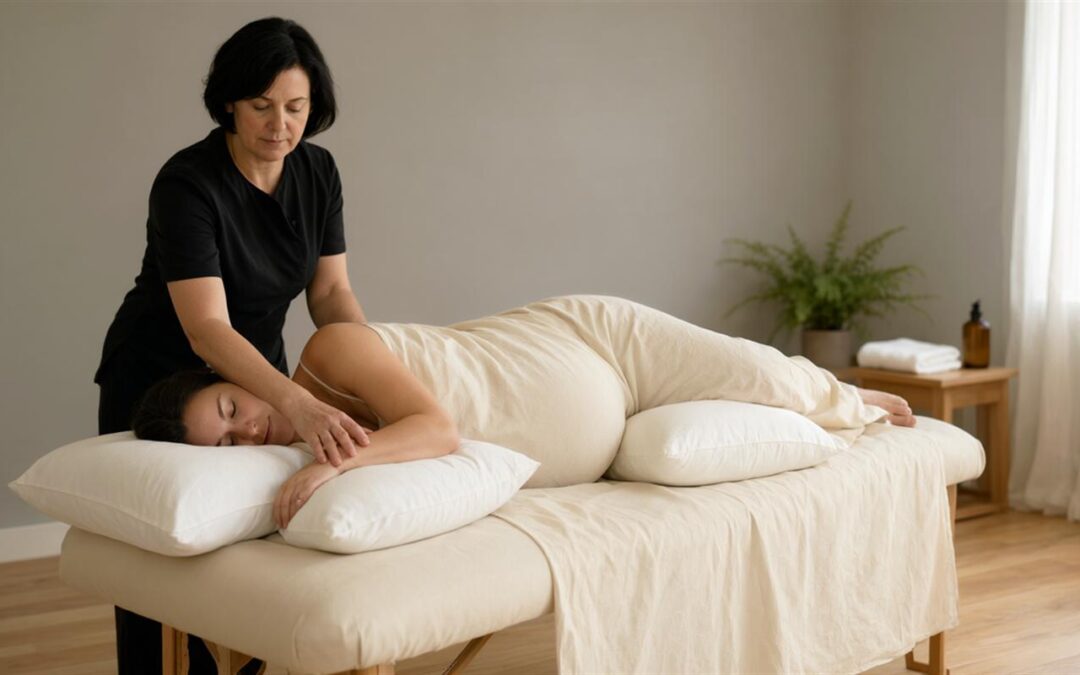
Most people who search “prenatal massage vs regular massage” are not deciding whether they want a massage. They are trying to work out why the same appointment seems to be planned differently once pregnancy is part of the picture. The honest answer is that the two sessions share a great deal: the same hands-on work, the same table, the same conversation about pressure. What changes is the setup around you. How you lie down, what gets asked before the session starts, and which areas the work is planned around all shift, and the details you mention at booking are what decide whether the appointment fits your body or merely happens to it.
The Short Answer: Same Kind of Session, Different Setup
A standard massage and a prenatal massage are both table work. Both involve a conversation about where you hold tension, both use pressure you can adjust, and both are shaped by what you say you want from the hour. Nothing about the technique becomes unfamiliar because you are pregnant, which is why prenatal massage vs regular massage comes down to preparation rather than to a different set of hands.
The difference sits one layer back, in the plan. A standard appointment can assume a starting position, a default amount of pressure, and a short intake. A prenatal appointment cannot assume any of those. The practitioner has to know how you are sleeping, which positions have stopped working, and what advice you have already been given, before the table is even set. That is why the booking conversation matters more here than it does for a routine session.
What Stays the Same in a Prenatal Session
Privacy and draping work the same way they do in any other appointment. You undress only to the level you are comfortable with, you stay covered throughout, and the practitioner keeps only the area being worked on uncovered. If you want more coverage, less of a particular area, or a change in how something is handled, you can ask, and the answer is not a negotiation. The standards for that do not change with pregnancy, and it is worth reading what to expect at a first massage appointment if the etiquette itself is the part that feels uncertain.
The pressure conversation stays the same too. Lighter, slower, firmer, or off an area entirely: all of it is available, and all of it can be repeated mid-session without apology. What changes is only the starting point, which is planned around your comfort rather than around a routine.
What Actually Changes When You Are Pregnant
Three things move, and none of them is the technique. The first is positioning. Lying face down for most of an hour is unremarkable in a standard session and often uncomfortable later in pregnancy, so the setup is rebuilt around what your body can tolerate. The second is the intake. Questions about pregnancy stage, provider guidance, and recent changes in comfort take longer to answer than “where does it hurt,” and they change the plan. The third is the map of the body. Some areas are worked differently, some are left alone, and the decision is made with you rather than applied by default.
Everything else in the wider menu stays available. MV Massage Therapy lists deep tissue, signature, hot stones, and aromatherapy massage beside prenatal massage and lymphatic drainage, and a prenatal appointment sits inside that same spa-wellness menu rather than apart from it. The service name changes the plan, not the atmosphere.
Positioning: Why the Setup Starts on the Table
A standard session usually begins face down, because that position gives easy access to the back and shoulders. A prenatal session more often begins side-lying, with pillows placed to support the belly, the space between the knees, and the top arm so the shoulder is not left hanging. The point is not comfort for its own sake. A body that is propped and supported does not have to hold itself up, which is the difference between a session you spend managing and one you spend settling into.
This is also where the most useful thing you can say gets decided. How do you sleep now? Which side? What happens when you lie on your back for more than a few minutes? Those answers tell the practitioner more about your setup than any general rule, and they are easier to give than a description of what hurts. The practice’s guide to what to expect in a prenatal massage session walks through how positioning is handled once you are in the room.
What to Mention Before the Session Starts
Read the booking message as the first half of the appointment. Four details do most of the work: how far along you are, anything a prenatal care provider has said about massage, what has changed in the last few weeks, and what you want left alone. The last one is the most often skipped and the most useful. A practitioner who knows that the lower back is welcome and the abdomen is not can plan the hour from the first minute instead of checking in every ten.
Recent changes are worth naming even when they seem small. A week of poor sleep, a new tightness across the ribs, a spot that feels tender when you turn over: each one points at a different plan. If you are not sure what to raise, the practice keeps a list of questions and comfort preferences to discuss before booking, and reading it before you write the booking message is a reasonable way to prepare.
Pressure, Areas, and the Words That Get You There
You do not need vocabulary to ask for what you want. “Lighter,” “slower,” “not there,” and “more of that” are complete instructions. The only thing that makes them work is saying them early enough to matter, which in practice means the first few minutes rather than the last ten.
It helps to separate pressure from area, because they are two different requests. You may want firm work across the upper back and nothing but light contact near the hips. Saying both in one sentence gives a clearer plan than a general note about preference, and it holds for the whole session rather than for the moment it was mentioned.
Session Length, Location, and Booking Details
Length is one of the few places the two menus visibly differ. The prenatal massage service page lists two options, 60 and 75 minutes, while the standard Swedish relaxation massage page lists four: 45, 60, 75, and 90 minutes. For a first prenatal appointment, the shorter of the two is often enough, because the intake takes time out of the hour and the positioning takes a few minutes to settle.
Setting works the same way it does for any other service. In-home and mobile massage is offered for Vienna and Fairfax, with the exact address and coverage confirmed at booking rather than assumed from a map. The practice’s contact page lists hours as open every day from 11am to 8pm, and it is also where a question goes if you would rather ask before committing to a time.
When the Question Is Really About Comfort
Sometimes “prenatal massage vs regular massage” is really a question about sensation. Heat and scent are the two things that most often change during pregnancy, and both are optional. The menu lists hot stones and aromatherapy as separate services, so neither is folded into a prenatal session by default. What can be added, and how much, is settled when you book.
Room temperature belongs in the same conversation. A room that felt fine in a standard session can feel too warm or too cool when you are spending an hour on your side under a sheet. Say so at the start, and say so again if it shifts. Those adjustments cost nothing and change more about the hour than most technique choices do.
What a Prenatal Massage Is Not
It is not prenatal care, and it does not stand in for a visit with the provider who is managing your pregnancy. A massage appointment has no diagnostic role: nothing is examined, assessed clinically, or decided on your behalf. When something needs a provider’s view first, that conversation belongs before the booking, and a practitioner who asks about it is doing the job properly.
Two details about the menu are worth knowing before you choose. Lymphatic drainage is provided by Margarita only, which matters if that is the service you were looking for, because the two appointments are planned differently. MV Massage Therapy also holds a post-op cosmetic surgery certification, listed on the site as Post-Op Cosmetic Surgery Certified, which is a separate service from prenatal work and is planned separately.
Key Takeaways
- The two sessions differ in setup, not in technique: positioning, intake, and the body map are what change.
- Say how you sleep and which positions have stopped working, since that decides the props and the start.
- Mention any guidance you have been given about massage during pregnancy when you book.
- Ask for pressure and area changes out loud in the first few minutes, then repeat them if they shift.
- Choose the length and the setting that suit this month rather than the whole pregnancy.
Conclusion
A session that fits is rarely the one with the most elaborate plan. It is the one where the details were said out loud early: how you are sleeping, what feels wrong when you lie down, what you want left alone, and how warm the room should be. Everything else follows from that, from the pillows under your knee to the pressure across your shoulders. MV Massage Therapy works with clients across Vienna and Fairfax, and the next step is to book a prenatal massage appointment, with your setup described in the message.