
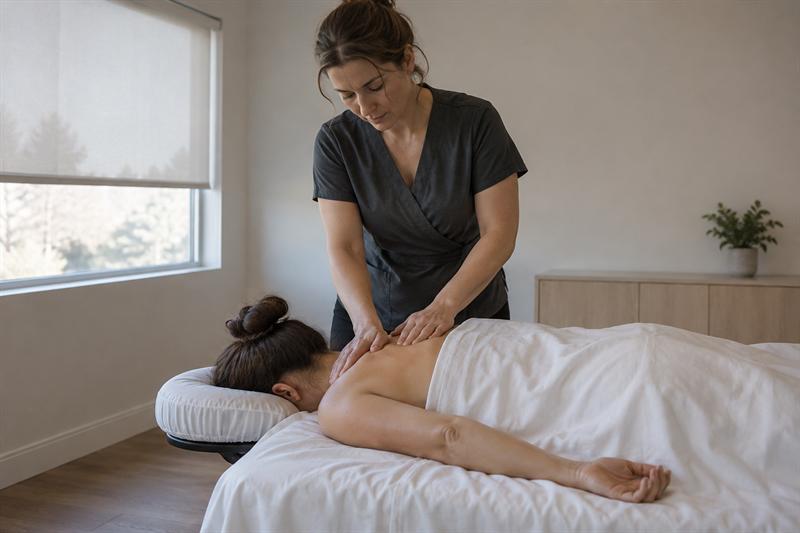
Quick Answer: Deep tissue massage is not a fixed-pressure routine: the session should reflect your priorities, health history, comfort, and boundaries. Expect a discussion of focus areas, privacy and draping, slower targeted work with adjustable pressure, and a wrap-up about how you feel.
Knowing what to expect from deep tissue massage means understanding more than how firm the pressure feels. You should also know how treatment areas are chosen, what stays covered, and how to request a change without waiting for the therapist to ask.
At MV Massage Therapy LLC, start by naming the areas you want addressed and any concerns about the experience. Deep tissue generally involves slower, focused work, but choosing it does not mean agreeing to the strongest possible pressure. The details of a session vary with the therapist’s approach and your needs.
Key Takeaways
- Your health history, preferences, and focus areas help shape the session.
- More time spent on one priority area leaves less time for other areas.
- You can request different pressure, decline an area, pause, or stop throughout the appointment.
- Soreness is not required for a useful session, and sharp pain is a reason to speak up.
Before Your Session: What to Share and Ask
A clear intake conversation helps establish what you want from the appointment and identify anything that affects the plan. “Firm pressure everywhere” describes an intensity preference. “Focus on my shoulders, but avoid my recently injured wrist” gives the therapist priorities and boundaries to work with.
Health History, Recent Changes, and Areas to Avoid
Share details that could change how or whether certain areas are addressed. Recent changes matter even if you have received massage before.
- Your main concern, where you feel it, and whether it has changed.
- Recent injuries, surgery, or unexplained symptoms.
- Pregnancy and relevant medical conditions.
- Medications that affect bruising or bleeding.
- Areas you want skipped and positions that feel uncomfortable.
This information helps the therapist set boundaries and decide whether to adjust the plan before the session begins. Recent surgery, for example, raises questions about positioning and area boundaries that routine tightness does not.
Use these questions to ask before booking a massage therapist to organize concerns about suitability, appointment details, and professional background.
Agreeing on Focus Areas and Available Time
Name your main priorities rather than expecting every area to receive equal attention. “Full body” and “spend most of the time on my shoulders” describe different uses of the available time. Make that tradeoff explicit before the session begins.
For example, extra time on the neck and shoulders leaves less time for the legs or lower back. Agreeing on what matters most helps prevent a focused session from feeling unexpectedly incomplete.
Also establish whether the booked appointment length includes consultation and dressing. A duration on a booking menu does not, by itself, explain how much hands-on time is included.
Clothing, Draping, and Getting Comfortable
Discuss clothing preferences and coverage boundaries before hands-on work begins. You do not need to justify a request for coverage or explain why you want an area left alone.
Privacy and Clothing Preferences
You do not have to agree to complete undressing. Discuss what you prefer to keep on and how that affects access to the areas you want addressed. Clothing choices can change the available techniques without removing your right to set boundaries.
In a typical draped massage session, you have privacy to change, and linens maintain coverage while agreed areas are accessed. Ask how the draping will work if you are unsure. Knowing what will be uncovered, and when, helps make the arrangement clear before you get on the table.
Positioning and Permission to Change the Plan
You can request a position change, support, a pause, or an end to the session. Agreeing to massage during intake does not remove those choices later.
Be specific: “Lying this way bothers my shoulder” gives the therapist information to act on. “Please skip that area” sets a clear boundary without requiring further explanation.
If the position itself is uncomfortable, changing pressure alone may not solve the problem. Pause and address the position before focused work continues.
During the Massage: Pacing, Pressure, and Check-Ins
A responsive session adjusts to your feedback rather than staying at a fixed intensity. Pressure, positioning, and time spent on each area are separate decisions, and any of them may need adjustment.
Gradual Pressure and Focused Work
Deep tissue massage generally uses slower, targeted work, with pressure adjusted as the session progresses. It does not mean maximum force on every body area.
A therapist might spend longer on a selected region instead of repeatedly moving across the whole body. Different areas also call for different approaches; pressure that feels comfortable on your back is not automatically suitable for your neck.
The useful question is not whether the work feels equally strong everywhere. It is whether the approach matches your agreed priorities and remains comfortable enough for you to receive without pushing through pain.
What to Say When Pressure Needs to Change
Speak up as soon as the pressure needs adjusting. You do not need to wait for a check-in or reach a particular number on a pain scale.
- “Please use less pressure.” This gives a direct instruction without requiring you to justify your tolerance.
- “That feels sharp,” or “I’m feeling tingling.” A reasonable response is to pause work on that area rather than continue through the sensation.
- “Can we pause and change position?” This identifies that the way you are lying, not just the pressure, needs attention.
When discomfort stays unspoken, the therapist may lack information needed to adjust the work. Silence is not a reliable measure of comfort, and you should not assume that a painful sensation is necessary because the therapist has not asked about it yet.
The guide to choosing light, medium, or firm massage pressure offers a starting point for describing your preference. The label starts the conversation; your feedback guides the session.
Why One Session May Not Cover Every Area Equally
A focused session divides time according to priorities, not equally across body parts. Slower work and comfort adjustments also affect how many areas receive attention.
Suppose the initial plan includes shoulders, back, and legs, but shoulder positioning takes extra time to resolve. Rushing through every remaining area could compromise the original priority. Revisiting the plan is more useful than treating the initial list as a requirement.
Settle the session plan before choosing your appointment. A more detailed conversation is useful if:
- You want focused work on several areas within limited time.
- A previous massage felt too intense, and you would like a clearer way to request changes.
- You need particular areas avoided or cannot comfortably use a certain position.
Give MV Massage Therapy LLC those details when arranging the session. They call for a discussion of priorities, boundaries, and available time, not simply a request for “deep pressure.”
At the End: Wrap-Up and What You May Notice
A useful wrap-up captures how the session felt and whether anything needs attention. Decisions about another visit should follow that discussion, not an assumption that every first appointment requires a fixed series.
Sharing Feedback Before You Leave
Describe your response in concrete terms rather than deciding immediately whether the massage “worked.” Useful feedback includes whether the pressure stayed comfortable, which positions suited you, and whether anything feels different or concerning.
- Where did the pressure need adjusting?
- Did any position become uncomfortable?
- Which preferences would be useful to remember for another visit?
That information gives future planning more direction than automatically requesting stronger work next time. A session that felt too intense calls for a review of the approach, not a test of whether you can tolerate it again.
Soreness, Changing Symptoms, and When to Seek Advice
Temporary tenderness is possible after deep tissue massage, but it is neither inevitable nor a reliable sign that the session was effective. Little or no soreness does not mean the pressure was insufficient.
Do not interpret an uncomfortable after-effect as evidence that deeper work was needed. That assumption can lead to repeating an intensity that did not suit you rather than adjusting the plan.
- Mild tenderness: Notice whether it improves or worsens, and include it in any discussion of future pressure.
- Severe or worsening pain, substantial swelling, or unusual bruising: Seek medical advice rather than assuming it is routine soreness.
- Persistent numbness, tingling, or new weakness: Seek medical assessment instead of booking another massage to work through the symptoms.
Keep aftercare straightforward. Follow any individualized guidance from the session and your usual hydration routine. Extra water is not a blanket requirement after massage, and massage does not replace evaluation of persistent or unexplained pain.
MV Massage Therapy LLC offers deep tissue, Swedish/relaxation massage, prenatal massage, and lymphatic drainage by Margarita. The important distinction is suitability, not simply intensity. Pregnancy and recovery from surgery raise different considerations, so these services should not be treated as interchangeable versions of stronger or lighter massage.
Frequently Asked Questions About Your First Deep Tissue Massage
Does Deep Tissue Massage Have to Hurt?
No. Pain is not a required part of deep tissue massage. Focused pressure can feel strong, but sharp pain, tingling, or numbness are reasons to speak up immediately. The response might be less pressure, a position change, or stopping work on that area, rather than asking you to tolerate more.
Do You Have to Undress Completely for a Deep Tissue Massage?
No. Clothing preferences and boundaries are part of the session discussion. Draping maintains coverage while agreed areas are accessed. Keeping clothing on can change which techniques are practical, but that is a planning consideration, not a reason to accept exposure you do not want.
Can You Ask for Deep Tissue Massage on Just One Area?
Yes. You can request focused work instead of equal attention across the body. Prioritizing your neck and shoulders, for example, leaves less time for your legs or back. The plan still needs to fit the available time and your circumstances; focusing on one concern does not guarantee it will resolve in one visit.
Should You Choose Deep Tissue or Swedish Massage for Your First Visit?
Neither is automatically better for a first massage. Deep tissue generally emphasizes slower, targeted work, while Swedish massage is commonly associated with flowing, relaxation-focused strokes. Your goals and preferences matter more than experience level. The deep tissue versus Swedish massage comparison explores the choice beyond pressure alone.
Can You Book Deep Tissue Massage While Pregnant or After Surgery?
Do not assume a standard session will be appropriate. Pregnancy and recent surgery affect positioning, treatment areas, and suitability, so disclose them before selecting the service. After surgery, restrictions from your surgical team matter. Prenatal massage and lymphatic drainage are distinct approaches, not simply lighter deep tissue sessions.
Conclusion: Know the Plan Before You Book
Consider MV Massage Therapy LLC as a next step for discussing a deep tissue appointment. The issue is not just how firm the pressure feels. Unclear priorities, unspoken discomfort, and assumptions about coverage or timing can leave you with a session that does not match your expectations.
For readers in Vienna or Fairfax, start by reviewing our deep tissue massage page. When arranging your appointment, state your main focus area, pressure concerns, and any boundaries or health changes that affect the plan. Settling those details before hands-on work begins gives you and the therapist a clearer starting point.